
How to measure your bra size at home
You need a tape, a mirror and two minutes. Here is the method professional fitters use, and why the band matters more than the cup.
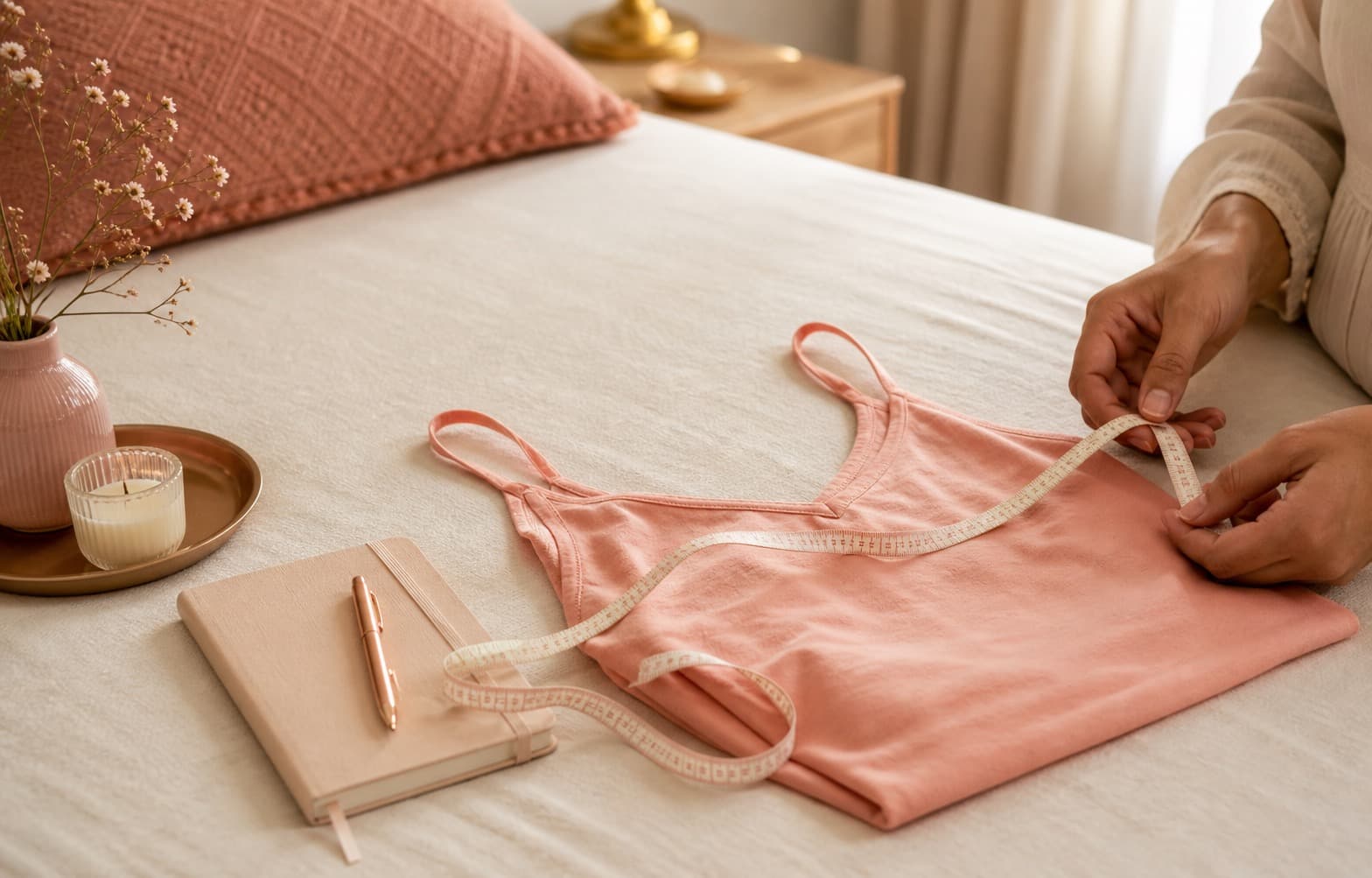
Most women are wearing the wrong bra size, and it is almost never their fault. Sizing is inconsistent between brands, rarely explained, and the advice you get in a shop often contradicts the advice you got in the last one.
Here is the method that actually works, and the reasoning behind it.
What you need
A soft measuring tape, a mirror, and an unpadded bra — or none at all. A padded bra adds volume that will throw the bust measurement off.
Step one: measure your underbust
Run the tape around your ribcage, directly under your bust. Keep it level all the way round — check the back in a mirror, because a tape that rides up behind you will read small.
Pull it snug. This measurement should feel firm, not loose, because the band is meant to be firm. Breathe out normally and read the number.
Round to the nearest even number. That is your band size. If you measure 31 inches, your band is 32. If you measure 33.5, your band is 34.
Step two: measure your bust
Run the tape around the fullest part of your bust, keeping it level and flat. Do not pull it tight — the tape should rest against you without compressing anything.
Step three: find your cup
Subtract your band size from your bust measurement. Each inch of difference is one cup size.
| Difference | Cup |
|---|---|
| 1 inch | A |
| 2 inches | B |
| 3 inches | C |
| 4 inches | D |
| 5 inches | DD |
| 6 inches | E |
So a 32 inch band with a 36 inch bust is a 4 inch difference — a 32D.
If you would rather not do the arithmetic, our size calculator does it for you, and gives you sister sizes to try as well.
The part nobody tells you: the band does the work
Around 80% of a bra's support comes from the band, not the straps. This single fact explains most bad bra experiences.
If your band rides up your back, it is too loose — and your straps are compensating, which is why they dig in. The instinct is to tighten the straps. That makes it worse. The fix is a smaller band.
Your band should sit level all the way round, and you should be able to slide two fingers underneath, no more.
Sister sizes, and when to use them
Cup volume is relative to band size. A 34C and a 32D hold roughly the same volume — they are sister sizes.
This matters when your size is sold out, or when a style runs slightly small. Going down a band means going up a cup, and vice versa:
- 34C runs tight in the band? Try 36B.
- 34C gapes at the cup? Try 32D.
Signs the fit is wrong
- Band rides up at the back — band too loose, go down a size
- Straps dig into your shoulders — the band is not doing its job
- Cup gapes or wrinkles — cup too big, go down a cup
- Spillage at the top or sides — cup too small, go up a cup
- Underwire sits on breast tissue — cup too small, not band too tight
Measure again every so often
Body shape changes with weight, age, pregnancy and time. Bands also stretch: even a well-made bra loosens over six to twelve months of regular wear, which is why you start on the loosest hook and work inward.
Re-measure once a year, and whenever a bra that used to fit suddenly does not.
- bra fit
- measuring
- size guide
- band size
- cup size
Keep reading
Style Notes2 min read
What to wear under a kurti, saree and fitted tops
The right innerwear disappears. A practical guide to layering under kurtis, sarees, sheer fabrics and close-fitting knits.

Fabric & Care2 min read
How to wash innerwear so it actually lasts
Hot water, wringing and the tumble dryer kill more bras than wear ever does. A short, practical care routine.